Showing posts with label Lupine Publishers Review. Show all posts

Saturday, 31 August 2019

Lupine Publishers | Straw Based Biorefinery

Lupine Publishers | Journal of Chemical Sciences


Abstract


In India energy security and exploring the production of valuable chemicals , which are otherwise mostly imported have become imperative necessity The advantage of abundant availability of paddy and its straws, specifically the rice straw in India are taken as an example to establish a perfect Bio-refinery . In these paper possibilities of production of chemicals and energy by Chemical, Biochemical and Thermo chemical platforms are explored. Possible alternatives on the problems of stubble burning in some stares of India are put forward. However, studies on the optimal design, and economic viability of each routes remain to be evaluated.

Introduction


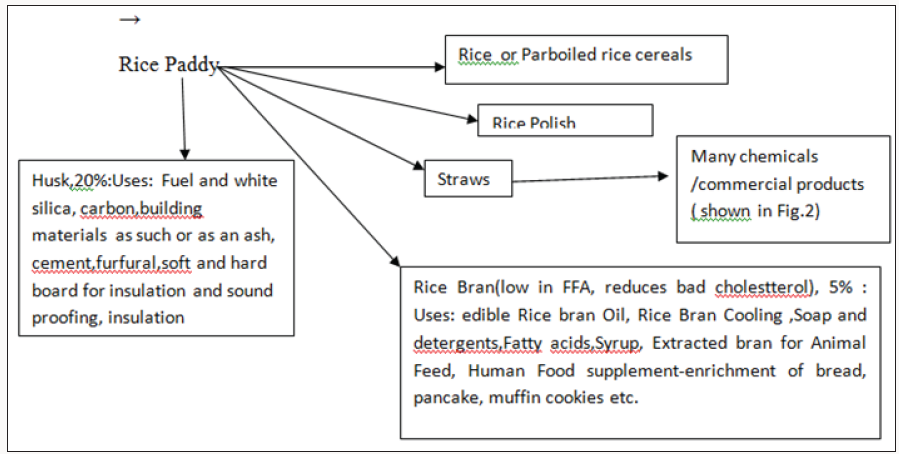
Biorefineries similar to petroleum refineries is a facility developed, engineered and designed optimally where renewable energy (heat & power) and multiples of chemical products and can be profitably manufactured from biomass with best known environmentally benign process technologies through biochemical and thermo chemical platforms. The energy production from bipomass is also Greenhouse neutral. Cellulosic biomass, because of its massive availability, can be a truly biorefinery representing a feedstock for biofuels and valuable chemicals. Agricultural residues such as straws are ideal candidates for establishing a biorefinery in India. Presently major quantity of straws is used as domestic fuels in rural areas. Rice Straw is produced from Rice Paddy. The various products and by-products are shown in the schematic diagram (Figure 1). On an average, there is 20% husks, 10% bran, 3% polishings, 1-17% broken rice and 50-66% polished rice. Generally Rice Paddy by-products is on an average 30% weight of paddy3).
Figure 1: Products and Bye-products from Rice Paddy (2).
Lupinepublishers-openaccessjournals-chemical-science
The residual wastes (stubbles) are usually burnt in the field which leads to severe air pollution problems due to discharge of gaseous pollutants including CO, Ozone , N2O, NOx, SO2 , CH4, particulate matters ,smokes and smogs, hydrocarbons. Open burning of crop stubble also results in the emissions of harmful chemicals like polychlorinated dibenzo-p-dioxins, polycyclic aromatic hydrocarbons (PAH’s) and polychlorinated dibenzofurans (PCDFs) referred as as dioxins, besides loss of nutritional values of soil intermas of organic carbon, nitrogen, phosphorous and potassium in many states of India, especially Punjab, Haryana, Rajasthan and Uttar Pradesh. This is not that extent in other part of India. The main reasons are: larger length of the stubbles remains after harvesting in those states which cannot be economically covered under soil to enhance the fertility of the land and attempts to burn these long projected straws over the agricultural land. In the following paragraphs some alternatives to straw stubble burning are suggested [1].
Due to continuous depletion of non-renewable energy resources and high cost of chemicals due to import, at present there is a worldwide attention towards development of renewable resources of energy and chemicals for sustainable development for the welfare of mankind. For example: Economic production of bioethanol from lignocellusic biomass. Conversion of lignocellulosic plant materials to biochemicals is also regarded as one of the most promising alternatives to fossil fuels. Most abundantly available biomass in the countries like India and China are straws (rice, wheat, oats, rye, barleys, Zea Mays, corn stalks etc.), out of which rice straw occupies the first position and followed by wheat straw in terms of availability in Eastern, and North Eastern Indian states (West Bengal, Bihar, Assam, Orissa, Manipur etc.) whereas reverse is true for Northern India (U.P. Haryana, Punjab, Rajasthan etc.).

Conventional but Economic Uses of Rice Straw and Stubbles


a) Soil improver to increase the fertility
b) Manuring/Composting with cowdung and others etc.
c) Briquettes
d) mats
e) Mushroom cultivation(as growth substrate)
f) Vegetables Cultivation
g) Animal Bedding material
h) Poultry Litter & Mulch
i) Feed for ruminants/Animal feed
j) Packaging goods for transporting goods &machineries
k) Frost prevention in horticulture
l) Strawberries (preventing damage to the fruit)
m) Thatching
n) Rope making
o) Traditional building materials, fibre boards,Particle board, insulation material
p) Energy (heat, power, fuels)
q) An intergrated solid state fermentation approach for production of enzymes from agro-wastes including straws
Lignocellulosic biomass could thus be utilized for both production of biofuels as well as biochemical’s due to its nature of renewability, low price, widespread availability and containing high content of pentose and hexose sugar polymers. These are detailed elsewhere [2-6]. Straw and Stubbles can be used for various Chemicals, valuable products and energy. The most notable products which can economically manufactured are: Pulp & Paper, Particle Board, Pulp and Paper Board, Straw board, board of rice husk.
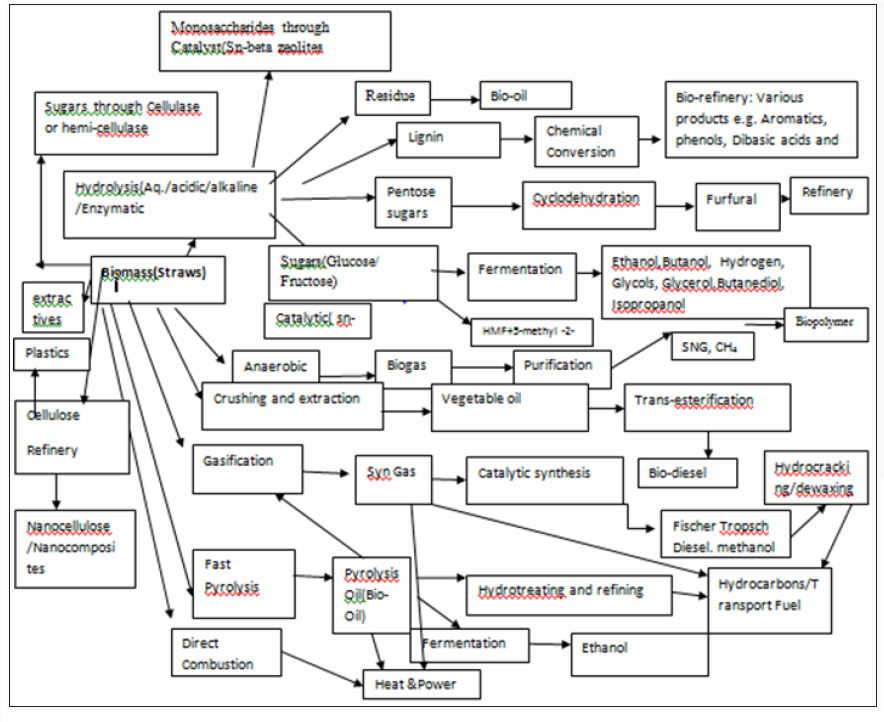
Energy technologies and thermal combustion consists of Non- Conventional uses of straws. Valuable chemicals include Cellulose, High Alpha cellulose, Plastics, Fuels and Energy,Bio-gas and in situ, Bio-oil, Nanocellulose and nano composites, Pentosans, Xylose, Xylitol, α-Cellulose, Glucose , Fructose, Hydroxy methyl Furan, Ethanol and host of many other chemicals [7-10]. These are shown in Figure 2.
Refineries based on Cellulose, Ethanol, Sucrose, Glucose, Lignin have been proposed and given elsewhere various Unit Operations and Processes involved to produce a biorefinery are as under:
a) Pulping
b) Gasification
c) Pyrolysis
d) Destructive distillation
e) Plasma Treatment
f) Chemical Treatment
g) Electron Irradiation

Chemical platform

a) Activated carbon
b) Chemical transformation through Catalyst(Sn-beta zeolites)
c) Synthetic Fuel using Solar Furnace
d) Cellulose nano crystals and nanocomposites:
Cellulose nanocrystals have been largely applied as reinforcing fillers in the preparation of nano composites materials with improved mechanical and barrier properties.
Figure 2: Products and Bye-products from Rice Paddy (2).
Lupinepublishers-openaccessjournals-chemical-science

Bio-chemical platform

Bio-chemical platform
a) Renewable fuels: Ethanol, Biodiesel,Butanol, Hydrogen
b) Chemicals: Acetone,Furfurol,Propanediol, Ketones etc.
c) Organic Acids:Acetic, Lactic , Succinic, Gluconic, Butyric etc.
d) Bio-Energy: Lignate, Methane, Bio-gas, Heat, Electricity
e) Food & Feed: Single Cell Protein,Fat,Fiber, Sugar etc.

Chemistry of Formation


Monosachharides

D-Xylose,D-glucose, L-arabinose,Xylitol,fructose,D-mannose,Dgalactose

Hemicellulose

Furfural, through acid treatment, Biogas by anaerobic Digestion, concentrating to Animal Feed. Fructose /Fruit sugar →Hydroxymethyl furfural (HMF) →catalytic processes → Plastics, diesel fuel additives, or even diesel fuel [11,12].

Chemical or Biochemical Platforms: Dilute acid hydrolysis of lignocelluloses:

Acids: Carboxylic acids such as formic acid, acetic acid, 3-hydroxy propionic acids, succinic acid, fumaric acids, Malic acids, Itaconic acids, Levulinic acid, Glucaric acids, glucuronic acid, Vanillic acids, Syringic acids, Ferulic acids, p-coumarlic acid. Amino acids like Aspartic acids,Glutamic acids, Aldehyde: Syringaldehyde
Polyphenols: glycerol, Arabitol, Xylitol, Sorbitol Lactones such as 3-hydroxy butyrolactone
Phenolics: p-hydroxy benzoic acids and vanillin However,aldopentose xylose (20-40% of the total carbohydrates are normally found in agricultural residues.
Reaction Schemes (4,9,21,29,30)
Chemical reaction consists of series, parallel and combination of series-parallel reactions
Cellulose (Glucan)→ Oligosaccharides →Glucose →HMF→Levulinic acid
Hemicellulose →Oligosachharides→Sugars( xylose,arabinose, glucose, mannose, galactose)
Pentoses ( Xylose/ Arabinose)→ Furfural→ Furfural resinification and condensation products
Hexoses(Glucose/ Fructose ) → HMF→ Levulinic acid+Formic acid→Succinic acid

Furfural and HMF


Figure 3 Reaction Scheme and Kinetic models are developed (Pentosan( both xylan and arabinan) is hydrolyzed to both aldopentoses which are converted into two or more steps into furfural. Loss of furfural takes place due to side reactions which leads to condensation and to the formation of resins. Both levulinic acid and furfural can be produced from straw or any biomass & levulinic acid can be converted to succinic acid and formic acid [13].
Figure 3: Products and Bye-products from Rice Paddy (2).
Lupinepublishers-openaccessjournals-chemical-science

Chemistry of formation

Lupinepublishers-openaccessjournals-chemical-science
Xylan Xylose Furfural: Hexosan →Hexose (Unit Cellulose) → 5-hydroxymethyl-2-furfural + 5-methyl -2-furfural
Mechanism:
Hydrolysis:
xylan + water →H+Xylose
arbinan + water →H+arabinose
Dehydration:
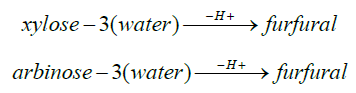
Lupinepublishers-openaccessjournals-chemical-science
Furan derivatives such as Furfural (2-furaldehyde), HMF (5-hydroxymethyl-2-furaldehyde), 2,5 furan dicarboxylic acids(33-35) are most important chemicals. HMF is produced industrially on a modest scale as a carbon-neutral feedstock for the production of fuels and other chemicals such as levulinic acid, gamma-valerolactone, or other byproducts. HMF itself has few applications and it is primarily produced in order to be converted into other more useful compounds [14-20]. Of these the most important is 2,5-furandicarboxylic acid, which has been proposed as a replacement for terephthalic acid in the production of polyesters. HMF can be converted to 2,5-dimethylfuran (DMF), a liquid that is a potential biofuel with a greater energy content than bioethanol. Hydrogenation gives 2,5-bis(hydroxymethyl) furan. Acid-catalysed hydrolysis converts HMF into gamma-valerolactone, with loss of formic acid. HMF is practically absent in fresh food, but it is naturally generated in sugar-containing food during heat-treatments like drying or cooking. Along with many other flavor- and color-related substances, HMF is formed in the Maillard reaction as well as during caramelization. In these foods it is also slowly generated during storage. Acid conditions favour generation of HMF. HMF is a well known component of baked goods. Upon toasting bread, the amount increases from 14.8 (5 min.) to 2024.8 mg/kg (60 min). It is a good wine storage time−temperature marker, especially in sweet wines such as Madeira and those sweetened with grape concentrate arrope [21-24].

Fermentation Technology


Bio-Ethanol

Sachharomyces cerevisiae, Zymomonous Mobilis, Clostidium thermocellum, Ruminococcus albus- a bacterium are generally used for conversion of cellulose to ethanol. Theoretically 1kg of sucrose on inversion, gives 1.053 kg of invert sugar, glucose and fructose combined together. Further,one tone of invert sugar yields 644.8 litres of absolute alcohol(ethanol of 100% ) or 678.7 litres of rectified spirit.The net CO2 emission of burning a biofuel like ethanol is zero since the cO2 emitted on combustion is equal to that aabsorbed from the atmosphere by photosynthesis during growth of the plant(sugarcane) used to manufacture ethanol.
Inversion: C12H22O11+H2O→C6H12O6+C6H12O6
Sucrose + Water →Invertase→Glucose + Fructose (Invert Sugars)
Fermentation: C6H12O6→2C2H5OH+2CO2+27.8kCals xymase
Oxidation: C2H6O+3O2→2CO2+3H2O+Δ
Combined equation: C6H12O6+6O2→6CO2+6H2O+Δ
6CO2+6h2O+hv(light)→C6H12O6+6O2

Butanol

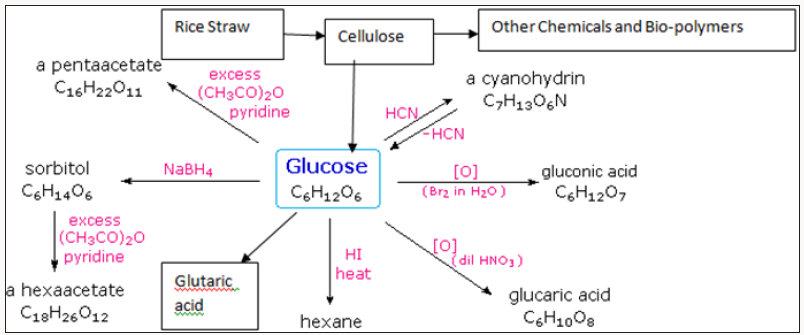
Biobutanol is produced by microbial fermentation, similar to bioethanol, and can be made from cellulosic feedstocks such as straws. The most commonly used microorganisms are strains of Clostridium acetobutylicum and Clostridium beijerinckii, C. Saccharoperbutylacetonicum and C. saccharobutylicum. In addition to butanol, these organisms also produce acetone and ethanol, so the process is often referred to as the “ABE (acetone-butanolethanol) fermentation [25-30]. Production of lactic acid from straw derived cellulose,cellulase production with Tricoderma citriviridae on solid bed, use of acid hydrolysates for lactic acid production using various strains such as Lactobacillus delbrueckii or lactobacillus pentosus can be explored.A number of products can be produced from sucrose as shown in Figure 4.
Figure 4: Products and Bye-products from Rice Paddy (2).
Lupinepublishers-openaccessjournals-chemical-science

Anaerobic Digestion

Biogas production (25,31-32), Anaerobic conversion of carbohydrate /cellulosics, especially of agricultural residues , has been considered for biogas ( methane) production which is typically, CH4=50-65%, CO2=35-50%, H2O=30-160g/m3, H2S=1.5-12.5g/ m3 inn presence of methane producing bacteria. Typically some of the methane forming microorganisms likes Methanaomonas, Methanococcous mazei n.sp. methannobacterium sohn genii n.sp. etc. are employed. The two best described pathways involve the use of acetic acid or inorganic carbon dioxide as terminal electron acceptors:
CO2+4h2→CH4+2H2O
CH3COOH→CH4+2CO2
During anaerobic respiration of carbohydrates, H2 and acetate are formed in a ratio of 2:1 or lower, so H2 contributes only ca. 33% to methanogenesis [31], with acetate contributing the greater proportion. In some circumstances, for instance in the rumen, where acetate is largely absorbed into the bloodstream of the host, the contribution of H2 to methanogenesis is greater.
Buswell and Symons universal equation:
CnHaOb+(n-a/4-b/2)H2O→(n/2-a/8+b/4)CO2+(n/2+a/8-b/4)CH4

Thermo-chemical platform

Gasification Technology
The basic principles of Gasification technology are as under:
a. Steam Reforming of Straws:
Superheated steam reacts endothermally (consumes heat) with the carbonaceous components of straws to produce hydrogen and carbon monoxide fuel gases (synthesis gas or syngas)
b. Steam Reforming reaction: H2 O +C + Heat → H2 +CO
Water –gas shift reactions also occur simultaneously with the steam reforming reactions to yield additional hydrogen and carbon dioxide.
c. Water gas shift reaction: H2 O +CO→ H2- +CO2

Conclusion


India being an agriculture based country with plenty of biomass renewable resources can produce potential bio-products and bio energy at a cheaper rate compared to other renewable sources. Being carbon neutral these resources is eco friendly, yields much less green house gaseous emissions compared to fossil fuels [32- 37]. In this present paper various alternatives for straw utilization, specifically the plausible solutions of current problems of straw stubble burnings in a few Indian states are highlighted. However detailed optimum design of process and plant with economic feasibility need to work out.

For more Lupine Publishers Open Access Journals Please visit our website: http://www.lupinepublishers.com/

For more Journal of Chemical Sciences Journal articles Please Click Here: https://lupinepublishers.com/chemistry-journal/

To Know More About Open Access Publishers Please Click on Lupine Publishers https://lupinepublishers.us/

Follow on Linkedin : https://www.linkedin.com/company/lupinepublishers
Follow on Twitter   :  https://twitter.com/lupine_online


Friday, 24 May 2019

Lupine publishers LLC | Lupine Publishers Review

Lupine Publishers LLC isa world’s leading Online Publishing repository, a genuine publisher with quality medical journals. Lupine Publishers LLC peer reviewed publisher is a multidisciplinary, scholarly Open Access publisher focused on Genetic, Biomedical and Remedial missions in relation with Technical Knowledge as well. Lupine Publishers LLC Online Open Access Publisher,craves to select ground- breaking research based on modernism, aptness, scientific connotation, prospective spectator’s interests, setc. Lupine Publishers LLC Online Open Access Publisher endeavor to provide by far and liberally accessible belvedere to researchers and practitioners in support of their novel and valuable ideas. Lupine Publishers LLCOnline Open Access Publisher already have 2000+ Editorial Board members along with 5000+ Published articles with them. Lupine Publishers LLC Online Open Access journals maintains a scrupulous, methodical, fair peer review System. Besides, quality control is riveted in each step of the publication process. Lupine Publishers LLC, strictly follows open access policy: Open access policies are part of rapidly growing researches in academia to enhance and encourage the new modes and techniques of scholarly publication by providing worldwide free access. Members of universities, schools and departments are establishing open access policies to make their research and scholarship more accessible to scholars, educators, policymakers, students and citizens worldwide. The only motto of Lupine Publishers LLC Open access Publisher is accelerating the scientific and technical research papers,considering the importance of technology and the human health in the advanced levels and several emergency medical and clinical issues associated with it, the key attention is given towards biomedical research. Thus, Lupine Publishers LLC asserting the requirement of a common evoked and enriched information sharing platform for the craving readers. Lupine Publishers LLC is such a unique platform to accumulate and publicize scientific knowledge on science and related discipline. Lupine Publishers LLC multidisciplinary open access publisher is rendering a global podium for the professors, academicians, researchers and students of the relevant disciplines to share their scientific excellence in the form of an original research article, review article, case reports, short communication, e-books, video articles, etc. Lupine Publishers LLC has quality journals which are self supporting, with no dependency on any other external sources (like universities, centers) for funds and strives for the best and enhanced quality publications competes the world wide open access publishing market. Lupine Publishers LLC always rely on the support from the members of the Lupine Publishers LLC family that is relevantly their Authors, Editorial Committee members, advisory board, Reviewers Board and all the technical support teams all over the globe. Lupine Publishers LLC trust in the reciprocated coordination and cooperation in terms of sharing the scientific knowledge of individuals and Groups of Research centers/areas will in turn educates and provokes in advanced researches. In this case Lupine Publishers LLC like to act as a media that anchors in the transformation of information in the form of global online publication.
2. Lupine Publishers LLC likes to bring world latest concept of open access video articles of research work at ease and cost-efficient manner. Lupine Publishers LLC aim to develop the integrated illustration approach to educational researchers and practitioners to encourage innovations and new research frontiers in scientific field. Lupine Publishers LLC provides advance platform for researchers for making their research work live and exemplify investigational visualization to the world. Lupine Publishers LLC also helps researchers to demonstrate their work by video to all young researchers, as this helps authors to get rapid acquaintance among their research community within short span of time. Lupine Publishers LLC invite video research articles in all diverse fields of Medical, Life Science, Health Care, Pharma, and other groups for publication in their Journals. Lupine Publishers LLC also accepts E-books that are written by scholars and influences the learning practice around the world. Lupine Publishers LLC, believes that E-books offer many potential benefits, to access when and where you want to read. Lupine Publishers LLC a great way to demonstrate knowledge in a creative way and is much more visually appealing than a white paper. The e-book has become the current standard form to have the research work available to the users. Lupine Publishers LLC offers high quality of PDF formats for their scholars to have their work available to the world. Lupine Publishers LLC, lightening fast lookup of the required information can now find through e-books as, it’s the hand library available of the users upon one button. Lupine Publishers LLC delivers high quality of e-prints that can be displayed in any electronic device. E-Books are the ones where every individual can afford, as they are freely available with Lupine Publishers LLC. In Lupine Publishers LLC, e-Books are embedded with a variety of multi- media elements which are not available with traditional books. Also, audio and video can be implanted to make reading comfortable while accessing the published articles. Lupine Publishers LLC provides article reprints with an aim to broadcast the research work in affordable and quality paper. Lupine Publishers LLC, indeed providing reprints is to explore the research work to the world in the format the user need. Lupine Publishers LLC reprints in two ways: Hard Copy: Lupine Publishers LLC, provide reprints with high quality & specially designed covers along with the journal name & logo on every page. Also, Lupine Publishers LLC provide customization option for cover Image. Or reprints will the mirror image of your articles. Electronic copy: E-prints of Lupine Publishers LLC are the electronic copies of article in PDF format. E-prints are print-enabled and allow users to print PDF for their use. The provided PDF link can be emailed or burned onto CD-ROMs.

https://www.slideshare.net/LupinePublishers/lupine-publishers-llc-lupine-publishers-review

Prediction of Physico-Chemical Properties for Polycyclic Aromatic Hydrocarbons Based on Electronic Characteristics of Molecules

Abstract QSPR models have been developed to predict of polycyclic aromatic hydrocarbons (PAHs) based on quantum chemical and integr...
